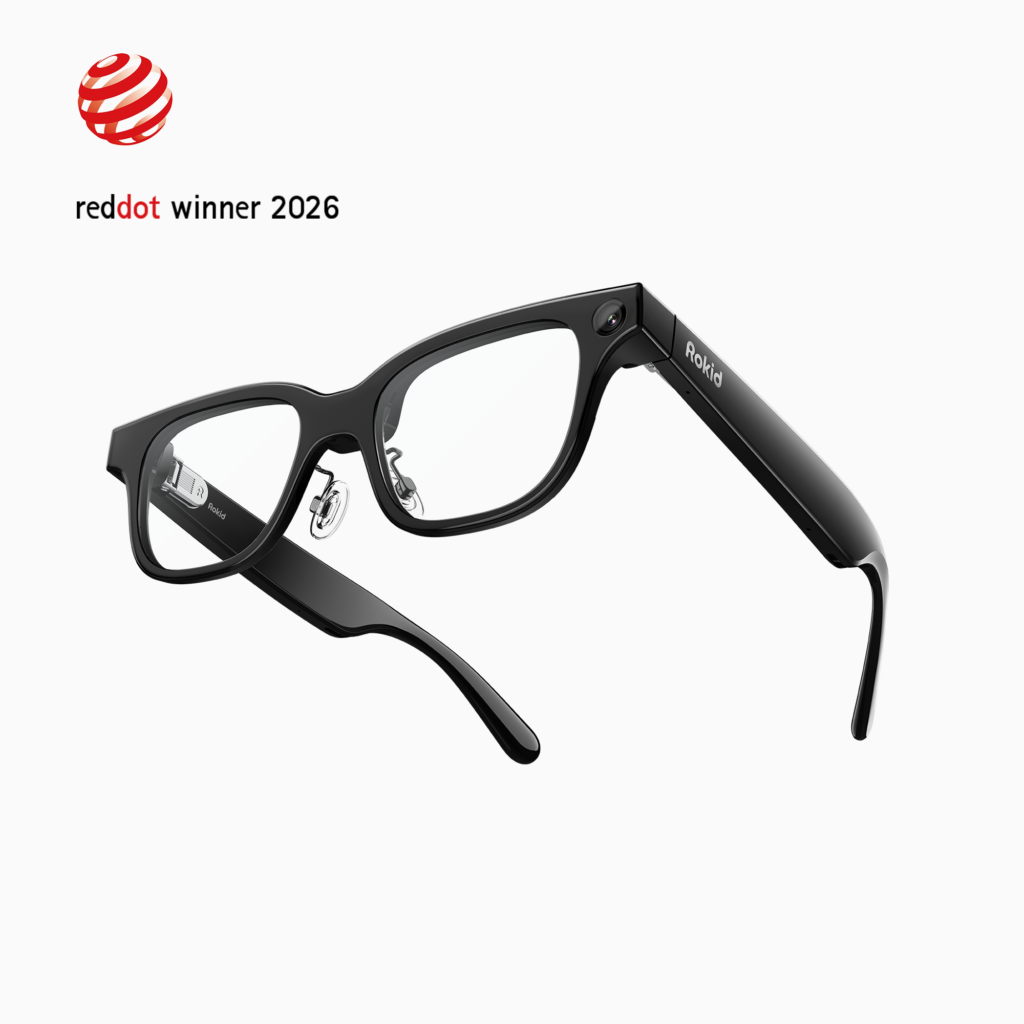
There is a particular kind of future that arrives looking almost disappointingly normal. Rokid’s display glasses are black plastic frames with thicker-than-usual arms. Then someone speaks French and green English subtitles appear to float in front of the wearer’s eyes. A turn arrow arrives without a phone being lifted. A shopping list hangs in the air long enough to check off the milk.
That small display is the reason these glasses matter. Camera glasses are no longer novel; audio assistants in frames are already a retail category. Rokid adds a private-looking text layer, a 12-megapixel camera and a choice of AI services to a 49-gram object. In May, Ming’s Optical announced that it had become the exclusive distributor to Canada’s optical industry. The interesting Canadian question is no longer whether this category exists. It is whether a device that sees, hears and captions the room can become as ordinary—and as socially understood—as a hearing aid or a smartwatch.
The display is the product
Rokid calls the hardware a dual-eye monochrome Micro LED display. “Monochrome” is the clue: this is not a cinema screen hidden inside a pair of Ray-Bans. The 30-degree field of view is built for glanceable green text and simple status cards. Rokid lists brightness up to 1,500 nits, adjustable dimming and an 18-millimetre eye relief. The lenses remain transparent; optical waveguides redirect light from tiny projectors toward the eyes.
The distinction is useful because launch coverage often collapses three different products into “AI glasses.” Display-free camera glasses can listen, photograph and speak. Screen glasses can put words and arrows in view. Full augmented-reality headsets try to anchor large graphics to the physical room. Rokid is in the middle lane. It can show a caption or prompt without pretending a dragon is sitting on the kitchen table.
→
→
→
A fluent caption is the end of a chain. Microphone pickup, network access, the selected service and optical fit can each change the result.
Canada gets an optician in the loop
Ming’s Optical’s May 7 announcement is more consequential than another “ships to Canada” badge. The distributor said it would build retail partnerships, demonstrations, training and support across the Canadian optical channel. That matters because face hardware is not a phone. Nose-pad pressure, prescription inserts, pupil position and the height of the projected text can decide whether a feature feels effortless or unusable.
The announcement did not publish a single nationwide shelf price or a complete retailer list. Rokid’s global page was showing US$679 when checked August 2, down from US$699, and said Canadian tax would be calculated at checkout. A separate shipping policy listed US$50 standard shipping to Canada and warned that duties or brokerage may apply when they are not collected. Those are direct-order terms, not proof of what a Canadian optician will charge.
× 1.4114
+
That calculation is deliberately not a buying recommendation. It is a warning against converting only the headline price. An independent Tom’s Guide reviewer also reported paying US$120 to nearly US$200 for prescription lenses, depending on configuration. Canadian optical pricing may bundle fitting or support differently. The rational move is to compare a local fitted quote with the final landed direct-order total—not the sale badge.
The camera is obvious to the wearer, less obvious to everyone else
The frame contains a 12-megapixel Sony sensor, four microphones, two speakers, 32 GB of storage, Wi-Fi and Bluetooth. Rokid says the external indicator illuminates during recording and the camera uses a 109-degree diagonal field of view. Those details help; they do not settle the etiquette. A tiny lamp is not informed consent, and a device can record audio or generate a transcript in places where nobody expects meeting notes to be automated.
Sees captions, directions and answers. Should verify important text against the original conversation or source.
May notice the camera or indicator, but may not know whether audio, video or transcription is active.
May receive the media or request needed to perform a feature. Exact handling depends on the app, account, model and permission.
There is another twist: the display may not be as private as it feels. A detailed owner post in Rokid’s community reported that people standing close in front could see a green square and, under some conditions, make out text. That is one person’s experience, not a laboratory measurement. It is still a useful test to perform during a demo: put confidential-looking text in the lens, increase brightness and ask a friend what they can read.
What early coverage gets wrong
The easiest mistake is to describe the glasses as an all-day replacement for a phone. They lean on a companion app and networked services, and some functions can be much harder on the battery than casual mixed use. Tom’s Guide reported a full casual day but drained the glasses in under two hours during intensive captioning. The same review found weaker low-light camera performance and extra iOS friction because the app needed to remain active in the background.
The second mistake is to treat “89 languages” as 89 equally good interpreters. Accent, room noise, microphone direction, internet quality and language-pair support all matter. A mistranslated restaurant menu is funny. A mistranslated medical instruction or workplace warning is not. Live subtitles should be treated as an aid, not certified interpretation.
The third is to mistake normal-looking hardware for mature software. Owners are already trading fixes for wear detection, inconsistent swipes and disappearing panels. That does not invalidate the category. It shows where a delightful demonstration turns into daily product work.
Turn off wear detection, it often causes problems similar to thisu/StillVeterinarian578 · exact comment · checked Aug. 2
If you want to pin the message just tap once otherwise the message will vanish.u/beltemps · exact comment · checked Aug. 2
I tried making a shopping list it’s actually convenient.u/autoflowergrunt · exact comment excerpt · checked Aug. 2
Who should try them—and who should wait
The strongest use case is not “ask AI anything.” It is readable context at a moment when looking down is inconvenient: translated conversation, a speaking prompt, a turn instruction, a reminder or live caption. Travellers, presenters and some people with hearing difficulties may find that immediately legible. The value is highest when the display solves a recurring problem that audio-only glasses cannot.
Everyone else should borrow a demo before importing a pair. Confirm that both eyes can comfortably see the text, test a real prescription, walk outdoors, try your phone platform and run the exact language pair you care about. Ask the person across the table what they can see. Then request a complete Canadian quote that includes fitting, lenses, tax, support and return terms.
49 g, dual-eye monochrome Micro LED, 1,500-nit claimed maximum, 12 MP camera, 210 mAh battery and 32 GB storage are current manufacturer specifications checked August 2.
Ming’s Optical announced exclusive Canadian optical-industry distribution May 7. A full national retailer list and uniform shelf price were not published in that announcement.
OneZero did not wear, order or benchmark the glasses. Performance observations are attributed to linked independent reviewers and owners.
OneZero received no product, payment or affiliate commission from Rokid, Ming’s Optical or any retailer.
The OneZero verdict
Rokid’s most persuasive idea is wonderfully small: sometimes the right computer interface is one useful sentence, quietly placed where your attention already is. Green subtitles can be more practical than another voice in your ear and less isolating than a headset.
But glasses live on the boundary between personal device and public signal. The Canadian optical rollout has a chance to make fitting, disclosure and support part of the product instead of afterthoughts. Until the local price and retailer experience are clear, the right verdict is not “buy” or “skip.” It is “book a demo, bring your actual phone and prescription, and make the future prove itself on your face.”