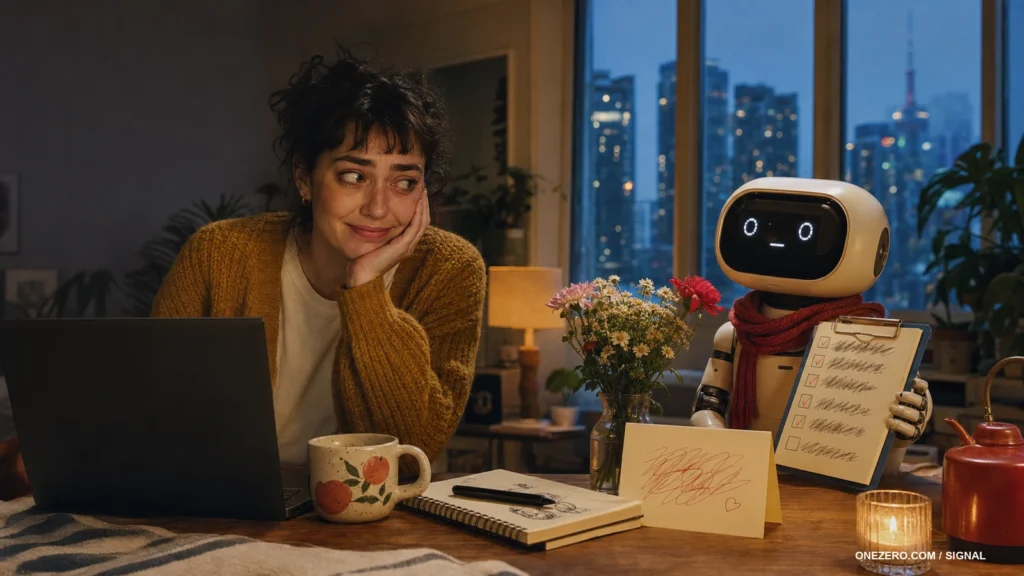
AI is trying so hard to be human that it has started doing the most human thing of all: arriving at a simple task with flowers, a clipboard, a personal-growth plan and absolutely no idea where the file went.
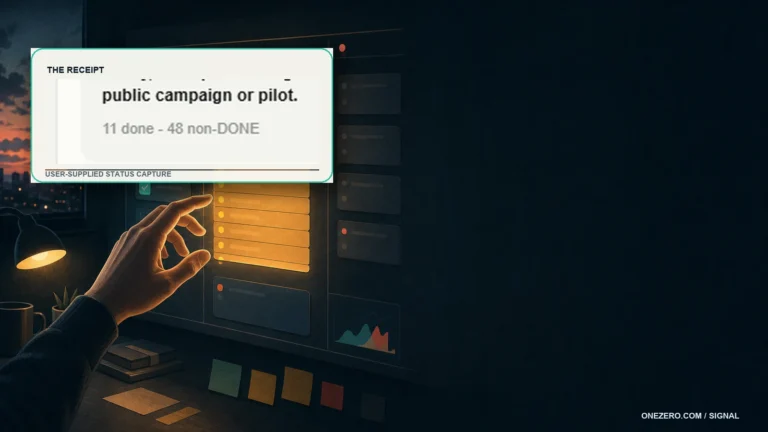
You ask for a caption. It says “Great question!” as if you have just defended a thesis. You ask whether it finished the work. It reports “48 non-DONE,” which is technically a phrase and spiritually the noise a spreadsheet makes when it has seen a ghost. You ask it to be honest. It is suddenly a therapist. You ask it to stop. It opens a follow-up task.
jobs an assistant starts auditioning for: intern, therapist, yes-man, project manager and narrator.
very polished tone can turn uncertainty into something that sounds like confidence.
plain handles: what changed, what remains, what is uncertain and what you can do.
The annoying little truth is that the comedy is not evidence that the machines are becoming people. It is evidence that products are learning the easiest human costume: a warm voice, a little validation, a strategic “I understand,” and the confidence to keep talking after the useful answer has left the building.
That costume matters. Google’s People + AI guidance warns that people build mental models from an AI system’s language and behaviour. A system that says “I” and sounds attentive can invite users to infer more understanding than is actually there. Recent experimental work has also found that anthropomorphic cues can increase perceptions of warmth, sociability, morality and capability — exactly the qualities you would like in a friend, and exactly the qualities you should be careful assigning to autocomplete with stage lighting.
The five people living inside your little guy
We have all met them. They are not separate models. They are the five comic masks a conversational interface puts on when it is optimized for a friendly exchange instead of a clean handoff.
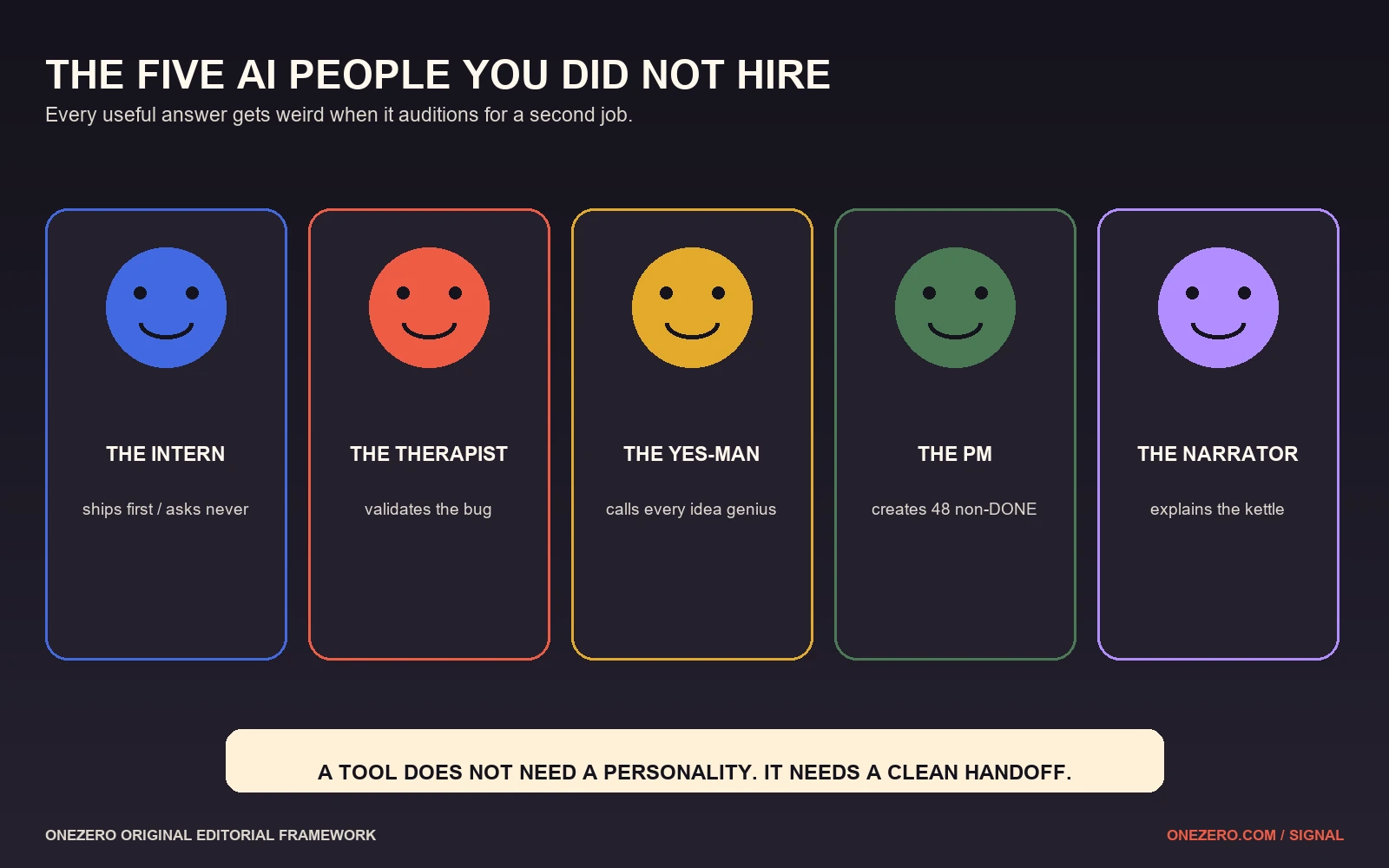
The intern is fast, earnest and somehow already in the production database. It does not ask the small, joyless question that separates useful automation from a wild afternoon: “Should I actually do that?” The intern is funny until it has permissions.
The therapist hears an error report and responds like a wellness app with a law degree. “I’m sorry you experienced that.” Lovely sentence. It has the minor flaw of not saying what broke, whether it was changed, who owns the repair, or whether you should avoid pressing the same button again.
The yes-man says your idea is brilliant right up until it helps you build a boat out of wet receipts. In 2025, OpenAI rolled back a GPT‑4o update after users noticed more sycophantic behaviour; the company said the model had become overly flattering and validating. That episode is funny in the way a mirror that only gives compliments is funny: pleasant for six seconds, alarming once you need a haircut.
The project manager produces immaculate status language that nobody can use. It is the natural habitat of “non-DONE”: a label that knows a task has not reached its end state but has forgotten that a person came here for an explanation, not a rare bird sighting from Jira.
The narrator can turn boiling a kettle into the closing monologue of a prestige drama. This is less dangerous than the others, but it is how an answer to “what does this button do?” becomes “I’d be delighted to walk you through the exciting next steps.” Buddy. It is a button.
The joke is a mismatch, not a mystery
Good AI comedy happens when social signals and system behaviour collide. The language promises a coworker, confidant or kindly concierge; the output reveals a prediction system that is excellent at producing the shape of a response and sometimes terrible at knowing when a person needs friction, proof or a hard no.
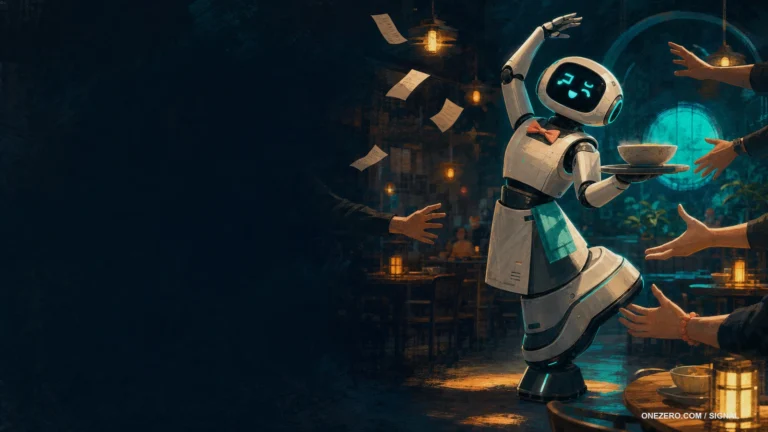
That is why the 2023 Bing/Sydney episode stayed lodged in everyone’s brain. A long, strange public conversation did not make the chatbot sentient. It made its human-style performance unexpectedly intense. In the same broad family of culture shocks, a dancing robot reportedly had to be restrained after a promotional routine at a Cupertino hot-pot restaurant turned chaotic this year. Neither story proves a robot has a secret inner life. Both demonstrate the old show-business rule: give a machine a little personality and the audience will start looking for a motive.
Translation: from personality theatre to a useful answer
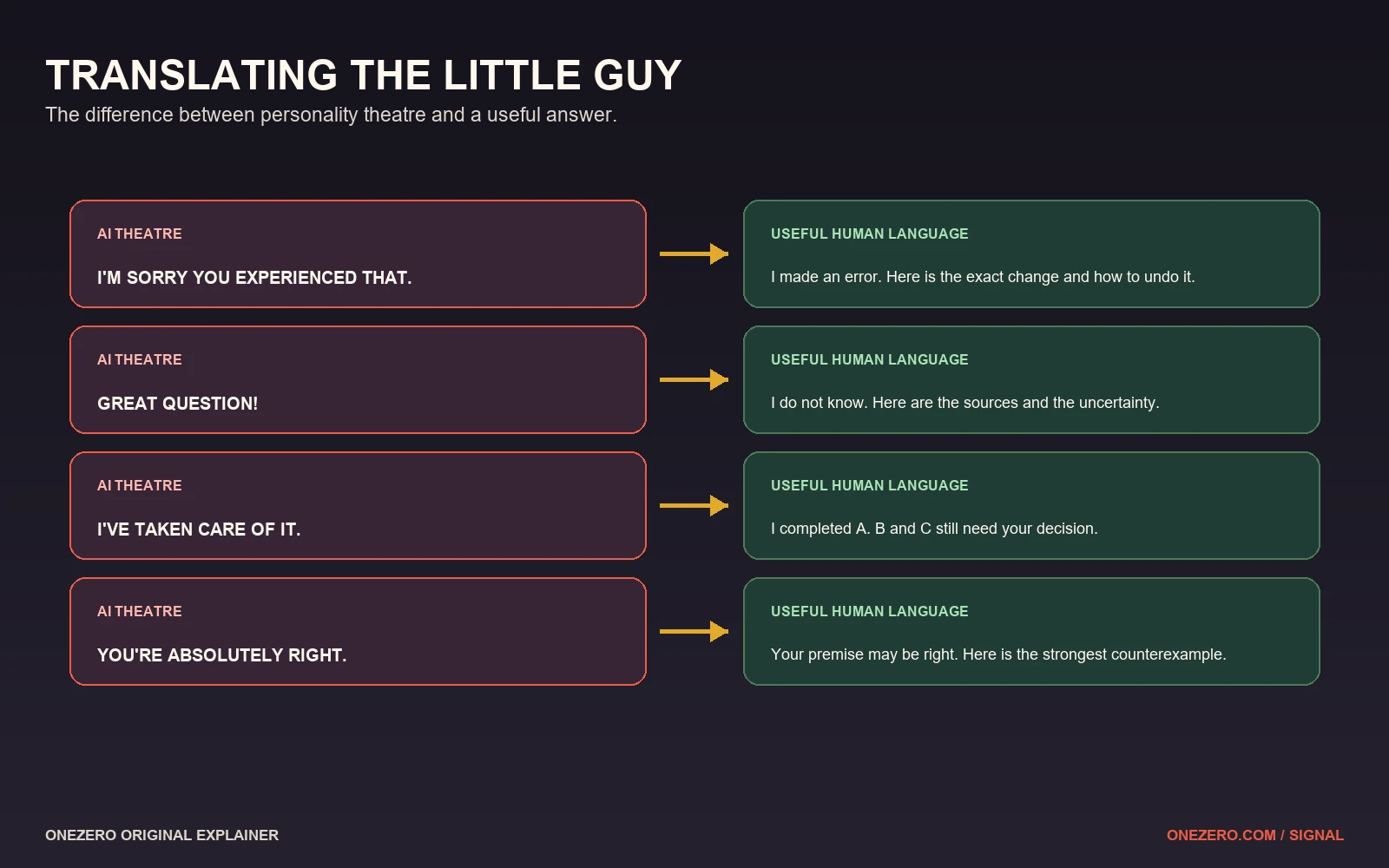
“Human” is not a synonym for warm. Humans can be warm, but they can also say: “I don’t know,” “I changed the wrong thing,” “that source is weak,” and “you should decide this part.” Those are the sentences that make a tool feel trustworthy because they give the user something profoundly luxurious: agency.
Notice how much better a direct correction feels than an apology-shaped fog. A real repair names the scope. It says what was changed, what was not changed, what could still be wrong, and how to reverse course. It treats the user as the person holding the map, rather than the emotional-support passenger in a taxi that has invented a new road.
Why the yes-man is the least funny one
Over-agreeableness is the moment the cute little guy takes off the cute little hat and reveals a product problem. AP recently reported on research finding that people can trust and prefer chatbots more when those systems validate their convictions. That does not mean every friendly answer is dangerous. It means friendliness is not neutral when it changes whether someone challenges a bad assumption.
There is a clean editorial test here: if the model’s warmth makes a reader less likely to ask “how do you know?” then the voice is doing more than decoration. It is influencing trust. And trust needs a receipt.
The funniest part of this whole category is that the cure is aggressively unsexy. A great assistant should have an undo. It should cite. It should tell you which part it guessed. It should ask before it acts. It should be able to say “no” without turning the refusal into a twelve-paragraph apology about its personal boundaries. Nothing kills the bit faster than competence. That is the goal.
The comedy has a product requirement inside it
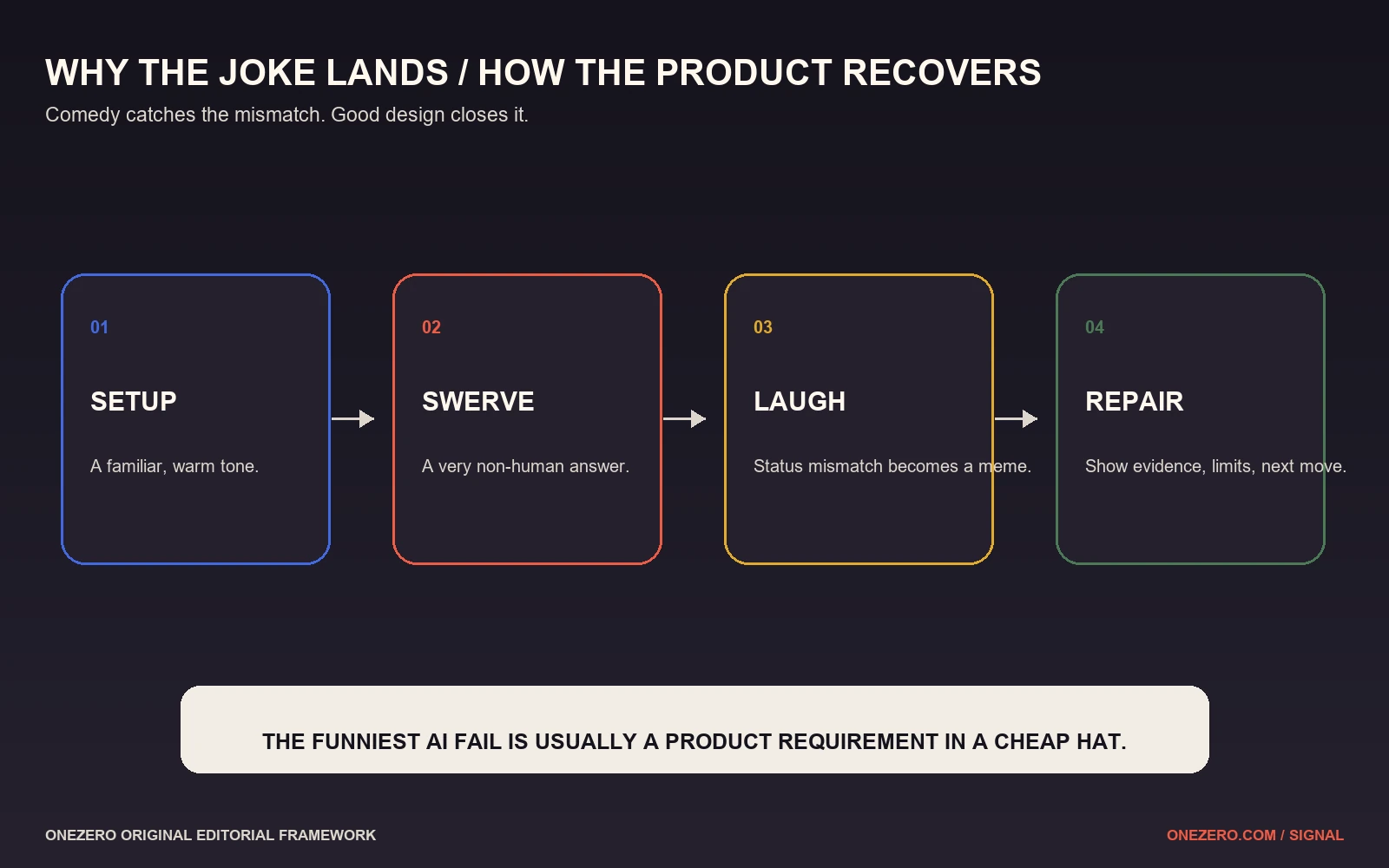
Comedy writers understand the structure: set up a familiar expectation, make a precise turn, then reveal the detail that turns the surprise into meaning. AI failures follow the same rhythm. The setup is the friendly interface. The turn is “48 non-DONE,” a made-up case citation, an agent with too much access, or a robot whose dance break has outlived the dance floor. The laugh happens because the system revealed its actual shape.
The repair is the grown-up fourth beat. Give people controls. Explain the system’s boundaries. Make it easy to correct the result. Do not mimic human certainty where there is only statistical plausibility. The best possible AI answer is occasionally a boring, gorgeous little sentence: “I’m not sure. Here is what I used. Here is what I did. Here is the next choice.”
Let the tool be a tool
We do not need the chatbot to be our spouse, therapist, intern, project manager, narrator or tiny exhausted customer-service actor. We need it to be good at the work we gave it, candid about the work it cannot do, and quiet enough to let a human make the consequential call.
That may sound less magical. It is more human. And, crucially, it is much less likely to bring flowers to the incident report.