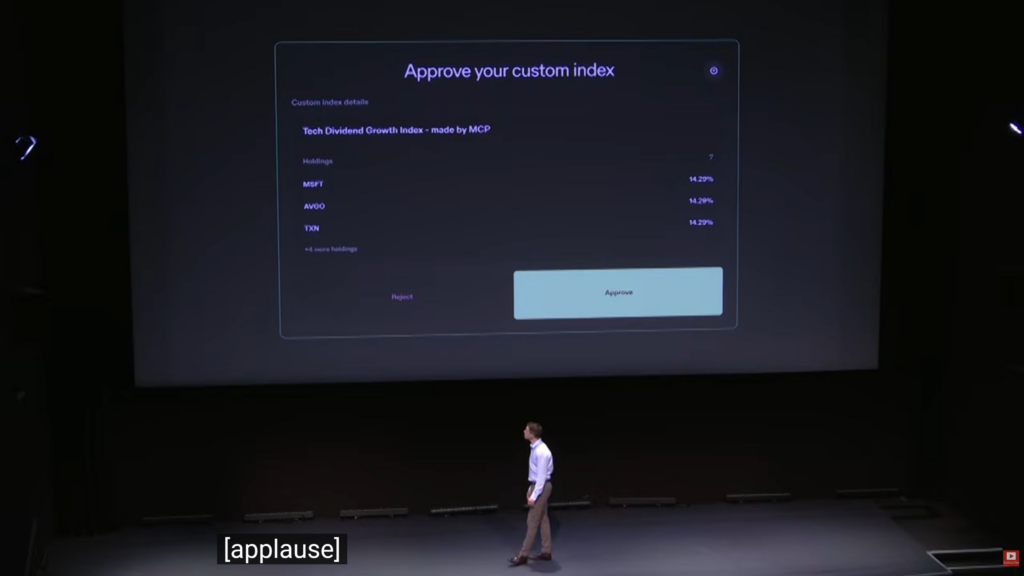
For years, “AI investing” mostly meant a chatbot explaining a stock after the market had already moved. Questrade has now put a Canadian brokerage account on the other side of the chat window. In its July product showcase, the company demonstrated an AI agent reading a portfolio, researching the market, building a seven-stock custom index and sending the proposed transaction to a phone for approval.
That last word matters. The interesting product is not a robot trader with a blank cheque. It is a carefully staged handoff: the AI can see, calculate and draft; the brokerage app still asks the human to make the consequential click. The line between those two states is where convenience, privacy, regulation and plain old investing judgment collide.
The moving pulse represents a request, not money. It stops at the approval gate until the investor acts.
A brokerage account became something an AI agent can talk to
The plumbing is called Model Context Protocol, or MCP. It is a shared way for an AI application to discover and use tools supplied by another service. Instead of copying a balance into a chat, the customer connects a supported AI agent to Questrade’s MCP server, signs in to Questrade, reviews the requested permissions and grants access.
Questrade’s live guide, checked August 2, lists Claude and Claude Code as supported connection routes; it says ChatGPT and Cursor support is coming. The beta can expose account and market data and can draft orders. Customers need version 2.0.0 or later of the Questrade app plus Push Approval. Questrade’s own warning is unusually direct: the third-party AI’s analysis, orders and custom indices come from that agent, not from Questrade, and the investor reviews and approves everything at their own risk.
The stage demo is worth watching because it shows a product claim becoming a user-interface claim. The screen does not say “the AI traded.” It says “Approve your custom index,” names the index as “made by MCP,” lists holdings and offers Reject and Approve controls. That is a better mental model than the phrase “agentic finance,” which can make ordinary permissions and a confirmation screen sound like financial autonomy.
Approval is not friction. Here, approval is the product
Push approval is the system’s circuit breaker and its most important design decision. A useful confirmation should identify the account, security, side, order type, quantity, estimated value, currency, time-in-force and any material fees. A custom index needs even more: holdings, weights, rebalance behaviour, cash handling and the assumptions behind the selection.
- Account and position summary
- Market-data retrieval
- Research synthesis
- Draft order or custom index
- Whether the information is current
- Whether the trade fits the real goal
- Whether size, account and currency are right
- Whether to reject or approve
This distinction also maps onto Canadian regulation. Questrade is an order-execution-only dealer: its self-directed clients make their own investment decisions. CIRO’s 2026 guidance says these dealers must make clear that decision-support output is not personalized advice, cannot be guaranteed to achieve a client’s goals and may be limited to the dealer’s own products and services. It also warns that tools designed to increase trading without a clear client benefit can create a material conflict.
In plain language: a brokerage can help you research and operate the account without silently becoming your adviser. But as the interface grows more conversational, that boundary becomes harder to feel. “Show me the dividend history” sounds like research. “Build me an index that will retire me at 55” sounds personal, even if the software responds with a disclaimer.
What leaves Questrade—and what revoking access cannot pull back
The connection is not merely Questrade adding its own chatbot. The customer authorizes a third-party AI agent to receive selected brokerage data. Questrade says permission can be revoked in Settings under API Access, but revocation does not delete information already shared with the AI provider. The customer therefore has two privacy policies to understand: Questrade’s and the chosen agent’s.
permissioned MCP connection →
Revoke closes future access. It does not recall data already transmitted. Check the AI provider’s retention, training and deletion controls before connecting.
That does not make the connection inherently reckless. It makes permission review a financial-security task rather than a setup nuisance. Use the narrowest available access, enable strong authentication, keep approval on a separate trusted device and periodically remove integrations you no longer use. Never paste the MCP server address into a lookalike site or accept a login prompt that did not originate from the connection flow you started.
The internet immediately found the emotional fault line
Questrade announced the feature in its verified Reddit community, where the original product post drew 39 upvotes and 47 comments when checked August 2. The reaction was not a simple cheer-or-jeer referendum. Some people wanted the brokerage to fix speed and pricing before adding AI. Others rejected AI in finance on principle. Questrade’s product account acknowledged a performance complaint and said it was still working on the issue.
Questrade Pro is still too laggy though! This should be first priorityu/mrbrown81k · 5 points when checked
AI should not be integrated into finance apps in any way, shape, or form. 0/10.u/Resident-Variation21 · dissenting comment
We’ve made strides here, and performance on Questrade Pro is a bar we never stop raising.u/Questrade-Product · verified response
Those comments are cultural evidence, not performance testing. OneZero did not connect a brokerage account or place a trade. The product is still a beta, the supported-agent list is limited, and an onstage path is not proof that every portfolio, browser, network and approval state behaves cleanly under pressure.
What the launch language gets wrong
The public flow still requires the investor to approve a proposed action.
The connected AI’s answer or draft is attributed to the third-party agent.
Claude routes are supported now; additional AI services are described as coming shortly.
This report analyses public documentation, the official demo, regulatory guidance and public reaction.
The phrase “nothing moves without your approval” is the claim to keep watching. Product teams can weaken approval without technically removing it: a preselected button, a tiny risk summary, repeated prompts, unclear currency or a confirmation that arrives after the user has mentally delegated the decision. The safest version makes rejection effortless and treats a timeout as no.
Five questions to ask before connecting your portfolio
- What exact data can the agent read? Account names, positions and balances can reveal far more than a ticker watchlist.
- Can it only draft? Confirm that submission still requires a separate, specific approval and that approval cannot be automated away.
- Where is the retrieved data retained? Read the AI provider’s privacy, training and deletion settings before authorization.
- What will the order ticket show? Account, currency, quantity, order type and fees should be obvious before approval.
- How do you disconnect it? Know the revocation route before you connect—and remember that revocation cannot unshare prior data.
The OneZero verdict
Questrade’s MCP connection is a genuine interface change. A Canadian can ask an AI about the portfolio the AI can actually see, then turn research into a structured proposal without manually rebuilding the account inside a spreadsheet. For a careful, experienced self-directed investor, that could remove tedious work.
It also compresses the distance between curiosity and capital. That makes the approval screen—not the chatbot—the star of the system. If Questrade keeps the permission narrow, the ticket explicit, the rejection easy and the third-party data boundary visible, the product may become a useful remote control for self-directed investing. If the conversational polish makes a generic model feel like a trusted adviser, the most dangerous feature will be how natural it feels.