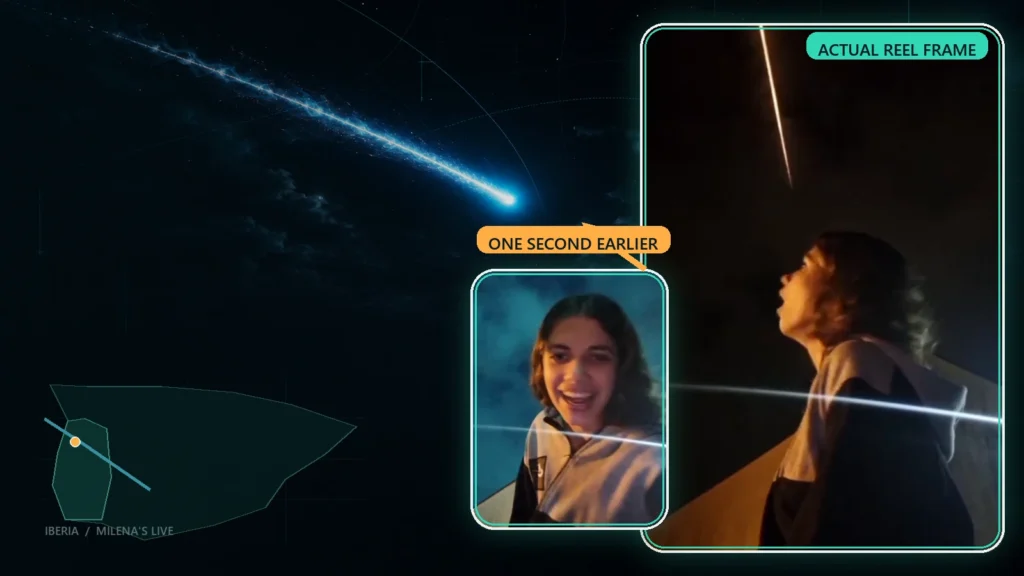
At 11:46 p.m. in northern Portugal, a 19-year-old student was about to end an Instagram Live from a local festival. Then the dark behind her became an impossible electric blue—and the internet acquired one of those clips that looks scripted precisely because no director could have arranged it.
Our central estimate for one pre-selected, 45-minute livestream catching a comparable event in frame. The transparent range runs from 1 in 770,000 to 1 in 42 million.
Oliveira de Azeméis city centre sits roughly 17 kilometres west of the published peak-light ground coordinate—about a 77-degree elevation angle.
The first thing to understand is that Milena Refacho was not waiting for the sky. She was drinking caipirinhas, talking with friends and broadcasting from a traditional celebration in Oliveira de Azeméis, in Portugal’s Aveiro district. Her live had begun around 11 p.m. local time. Forty-odd minutes later, a metre-wide object from space began to burn above western Spain, flew northwest for more than 500 kilometres and reached its brightest point almost over her.
Milena’s face changes before the viewer has time to understand why. The background flashes turquoise. A white-blue head cuts across the frame. Her friends shout off camera. For several seconds the ordinary grammar of a social video—one person, one phone, one night out—collides with a planetary event moving at roughly 40 kilometres every second.
Will Smith’s credited repostThis is the kind of shot that would inspire an entire movie scene.
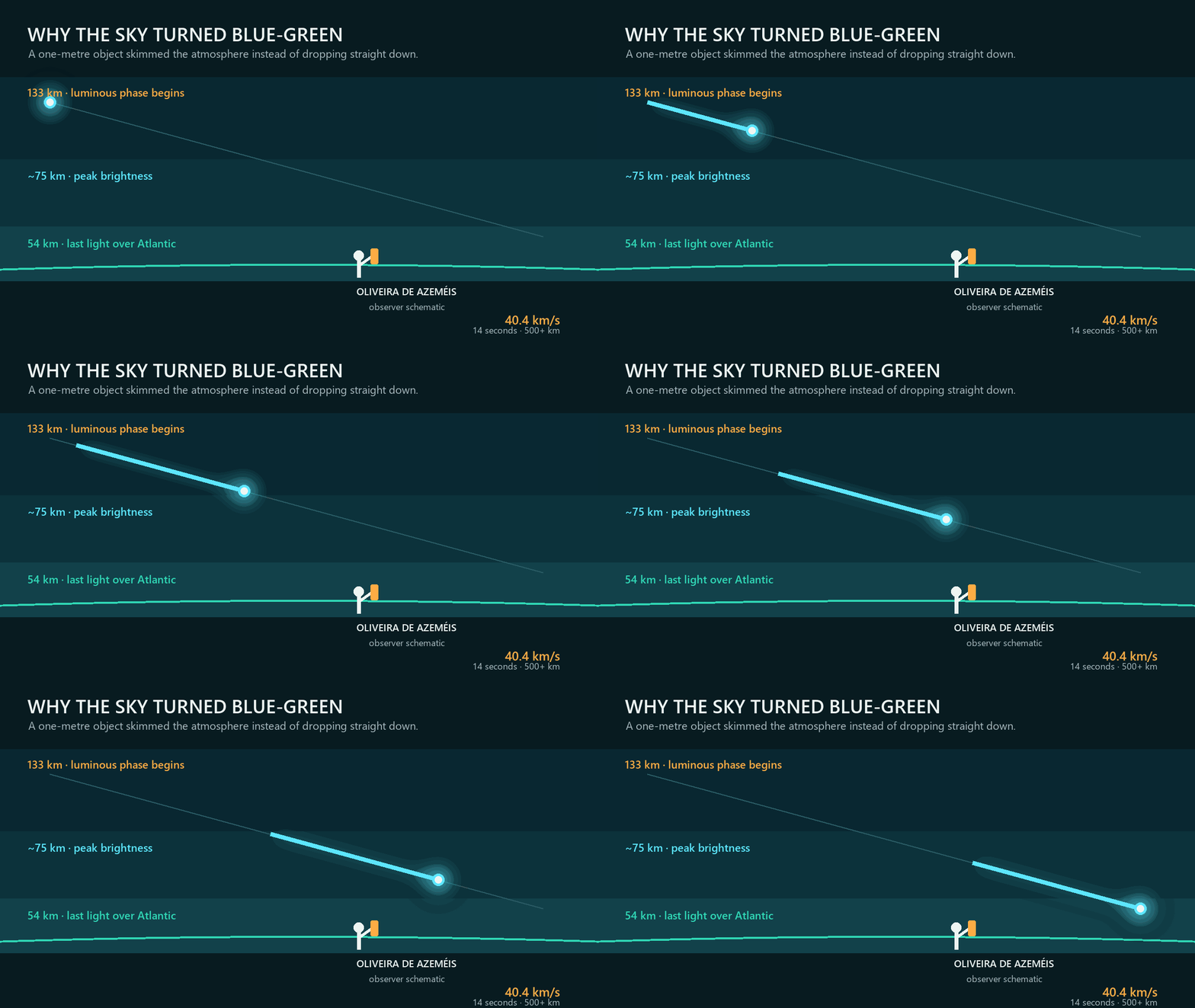
The entire 500-kilometre flight, in 14 seconds. The original Reel, verified comments, map and odds calculation continue immediately below.
The post everyone was trying to describe
Here is the original edited Reel—not a rip, reaction compilation or unattributed repost. Refacho’s account name has changed since 2024, but the post identifier is stable. By August 2026 it displayed 2.8 million likes and 16,600 comments. That is substantially more visible engagement than Will Smith’s credited repost, which displayed 758,400 likes and 5,500 comments.
The scene is so clean that many viewers assumed compositing. The edited version slows the moment and adds music; that polish matters, but the celestial event is real. Refacho later published the original-audio excerpt specifically because people were calling it fake. Professional sky cameras in Spain, private security cameras, car dashboards, weather satellites and hundreds of witnesses recorded the same flash from different angles.
ESA’s Cáceres fireball camera recorded it at 22:46 UTC on May 18. The Meteosat Third Generation weather satellite also detected the light from geostationary orbit.
The viral Reel is slowed and scored. The raw-audio companion preserves the shouting, laughter and confusion from the live. Editing changed the mood, not the meteor.
The visible object faded about 54 kilometres above the Atlantic. No collision with the ground appears in the clip, and recovered meteorites were considered very unlikely.
This was one exceptionally bright atmospheric event, formally catalogued as superbolide SPMN180524F—not a stream of small meteors radiating from one point.
She was almost under the brightest point
The later scientific reconstruction supplies the geographical punch line. The luminous path began about 133 kilometres above western Spain at 22:46:41 UTC. It crossed Portugal on a shallow northwest line and ended 14 seconds later, about 54 kilometres above the Atlantic. The energy peak occurred near latitude 40.85° north, longitude 8.28° west, at an altitude of about 74.5 kilometres.
Oliveira de Azeméis city centre is roughly 17 kilometres west of that peak’s ground coordinate. We do not have Milena’s exact camera coordinates, and a city-centre pin should not be mistaken for them. But the order of magnitude is startling: the brightest section was nearly overhead, at an approximate elevation angle around 77 degrees from the city centre. That is why the light appears to pour into the whole scene instead of sitting as a small streak near the horizon.
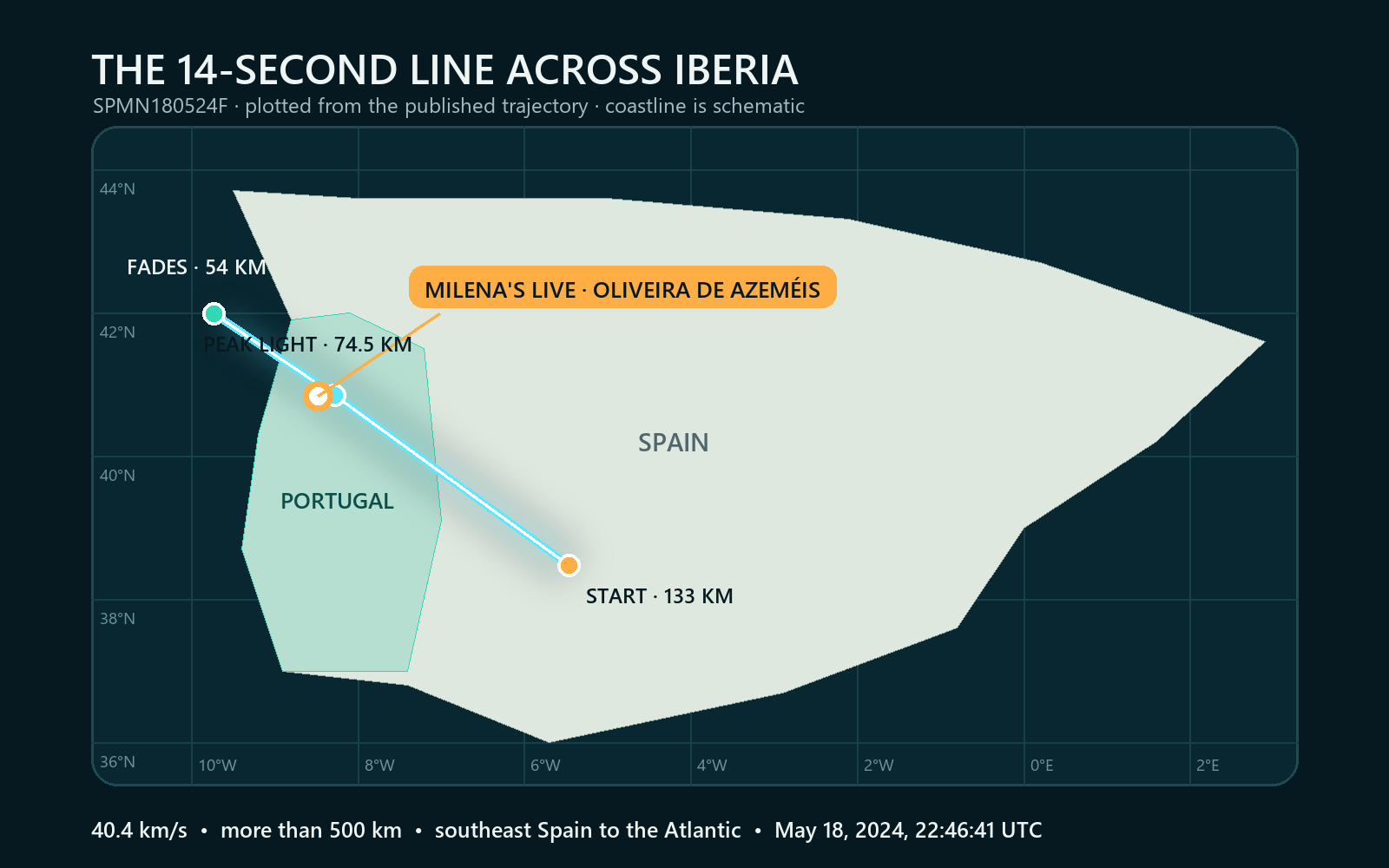
The map also explains the flood of recordings. This was a grazing entry, with a published average slope of only 8.5 degrees. A steep meteor can produce a brief local spectacle. SPMN180524F remained luminous across two countries. ESA reported observations as far away as the Algarve, Paris and Brittany; the actual brightness was tens of times greater than a full moon.
Meteor, meteoroid, meteorite—or comet?
The nouns became casualties of virality. A meteoroid is the physical object in space. A meteor is the luminous phenomenon created when it barrels through the atmosphere. A fireball is an unusually bright meteor; a bolide is a very bright, often fragmenting fireball. A meteorite is material that survives to reach the ground. Calling the blue streak a meteor is fine. Calling it a recovered meteorite is not.
Early ESA analysis described the intruder as likely a small piece of a comet. The later orbital study added useful precision. It measured a weak, roughly one-metre carbonaceous meteoroid with a mass in the several-hundred-kilogram range and traced its most likely source region to Jupiter-family comets, possibly related to sun-skirting objects. That does not mean a giant snowball-shaped comet flew over Portugal. It means the small body’s orbit and material history may lead back to that comet population.
Why was it blue-green?
The honest answer is more interesting than “it was made of nickel.” A fast object compresses and heats the atmosphere in front of it, strips material from its surface and creates a glowing cloud of excited atoms. ESA notes that excited oxygen can emit around 558 nanometres, in the blue-green portion of human vision. The American Meteor Society lists magnesium as blue-white and nickel as green, while warning that velocity, atmospheric gas, human vision and camera response all affect reported colour.
In other words, the colour is a spectrum problem, not a paint-chip test. Most of the glowing cloud around a fireball is heated atmospheric gas. Phone cameras then apply exposure, white balance, noise reduction and colour processing to a scene that jumps from darkness to near-daylight in a fraction of a second. The sky really did turn blue-green; the exact shade on one Reel is not a laboratory assay of the object.
The raw version is funnier—and better evidence
The unedited-audio companion has its own enormous audience: 1.3 million likes and 9,600 comments were visible in August 2026. It replaces the dreamlike soundtrack with people trying, in real time, to decide whether the sky has become day, whether they are imagining things, and whether this is somehow a mission from hell. That messy soundtrack is the authenticity layer the polished edit lacks.
The two versions form a tiny lesson in evidence. The edited clip is the object people share because it feels like a movie. The raw clip is the object people consult when they want to know whether the movie happened. Each makes the other stronger.
Why this one became the video
There were clearer scientific recordings. There were wider security-camera views. There were probably steadier phones. Milena’s won because it contains scale and emotion in the same frame. The viewer sees a person before the event, watches light alter the environment, then reads astonishment on a human face. The shot supplies its own before, interruption and reaction without an editor needing to explain any of them.
It also carries what marketing professor Jonah Berger calls the practical ingredients of contagious material: public visibility, strong emotion, a story people can retell, and immediate social currency. “Look at this meteor” is ordinary. “A student accidentally framed herself under the brightest part of a 500-kilometre fireball while livestreaming a village party” makes the sender feel as though they discovered a miniature film.
Then came the authority cascade. Portuguese news outlets interviewed her. International pages reposted it. Will Smith told his audience that the shot could inspire a movie scene and credited her. Every new layer gave hesitant viewers permission to believe—and gave people who had already seen it a reason to send it again.
Still gives me CHILLS. 💜@yesthatbobwest · verified
Original Reel · 4 likes when checked
This whole time I thought this was fake. Friggin awesome I’ve always wanted to see one 🙌😍@whatjamaican
Original Reel · 2 likes when checked
Portugal is back to conquiste the world.@funnyabel
Will Smith repost · original spelling preserved
Those reactions cluster around three ideas: awe, disbelief and protagonist energy. Viewers do not merely envy what she saw. They envy the completeness of the record—the face, the light, the trajectory and the timing arriving in one vertical frame. The camera did not remove the human experience; it preserved the exact instant a person’s expectations failed.
So what were the actual odds?
“One in a billion” appeared in early comments. It is a wonderful line and an indefensible calculation. No database records every 45-minute Instagram Live, every cloud layer, every phone field of view and every metre-class fireball. Anyone offering one exact probability without defining those inputs is manufacturing precision.
We can still build an honest order-of-magnitude model. Start with one specific 45-minute livestream in one year. Assume between 30 and 365 globally distributed metre-ish bright entries per year; a roughly 300-kilometre useful viewing radius; a phone framing between one-fifteenth and one-eighth of the relevant sky; and a 25-to-60-per-cent chance of a sufficiently clear, unobstructed view. Those assumptions are deliberately visible and adjustable. They do not pretend every metre-class entry is as luminous as this one.
A particular one-off live catches it in frame
≈ 1 in 4.7M
Sensitivity range: about 1 in 770,000 under generous assumptions to 1 in 42 million under conservative ones. Formula: annual event rate × time fraction × footprint/Earth surface × camera framing × clear sightline. This estimates a pre-selected person’s single stream—not the chance that somebody, among millions of cameras, would get a great recording.
The central result—around one in five million for that specific one-off live—makes the clip exceptional without inventing cosmic numerology. The global internet changes the second question. Billions of camera-hours accumulate across phones, doorbells, dashboards and observatories. Given enough recording, “someone got it” is far less astonishing than “this person got it with a perfect reaction and composition.” The meteor was rare. The accidental filmmaking was rarer.
The Canadian connection is listening, not looking
Canadians have one of the world’s most interesting meteor instruments in southern Ontario. The Canadian Meteor Orbit Radar near London can detect millimetre-scale meteoroids, measure speed and direction and reconstruct orbits even when nobody makes a viral video. That is the inverse of Milena’s phone: less cinematic, vastly more systematic.
The comparison is useful. A social clip tells scientists where public attention is; networks such as ESA’s AllSky7, the Spanish Meteor Network and Canada’s radar tell them what physically happened. The best reporting joins the two. It does not sneer at the viral video as frivolous, and it does not treat likes as laboratory measurements.
What survives after the algorithm moves on
By the usual internet clock, this should have disappeared in a week. It did not. New comments were still arriving in 2026. People returned to ask whether Milena had been frightened, to announce they had finally learned the clip was real, and simply to watch the moment again. The post became less like breaking news and more like a tiny public monument to coincidence.
Its durability comes from a tension no explainer can resolve: a one-metre remnant of the early solar system ended a sun-skimming journey above the Atlantic, while a student’s front-facing camera happened to be open beneath the brightest part. The scientific record makes the scene less magical only if facts are boring. Here, the facts are the magic.