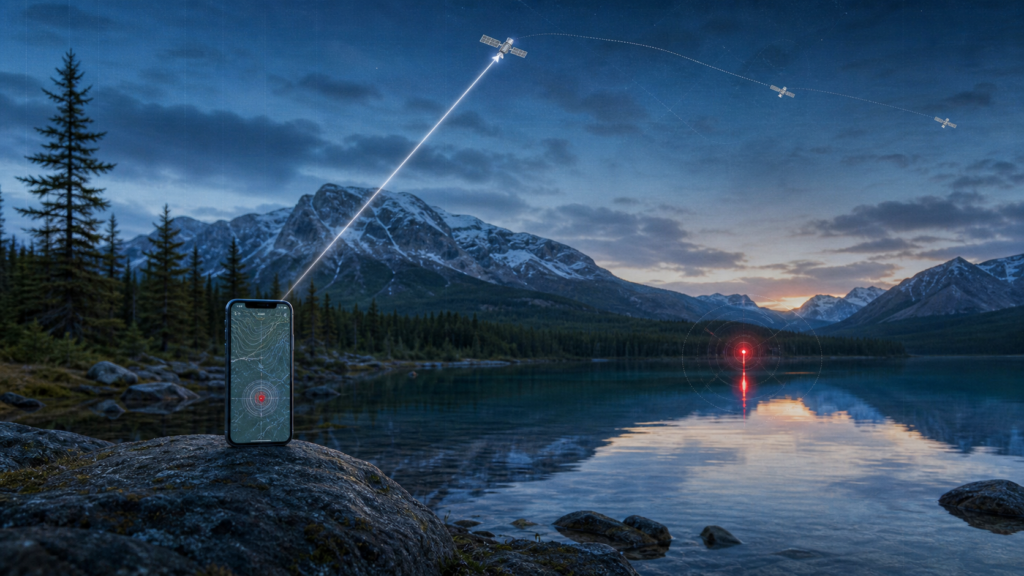
Canada is a difficult shape for a cell network. In 2025, Rogers began offering satellite text messaging that could connect compatible ordinary smartphones beyond terrestrial coverage. The service’s best feature was what it did not require: a separate satellite handset.
A person outside with a clear view of the sky could lose the cell signal and find a different network overhead. Text and text-to-911 were the beginning; data and voice were described as later ambitions.
For campers, northern highway drivers and remote communities, the distinction between a technology demo and a safety tool is reliability. The service was fascinating precisely because the moments that justify it are moments when failure matters.
What actually changed
The beta paired Rogers spectrum with low-earth-orbit satellites so supported phones could communicate without a conventional tower. Rogers opened the trial broadly and said it would initially support texts and text-to-911.
Direct-to-device service differs from traditional satellite messaging accessories. The phone’s existing cellular radio and the carrier relationship do more of the work, while a much more powerful antenna in orbit listens for the weak signal.

How it works, without the launch-event fog
A low-earth-orbit satellite moves across the sky much closer than traditional geostationary satellites. The network coordinates brief, low-bandwidth connections using carrier spectrum. Text is the sensible first service because messages tolerate delay and require little data.
The phone needs an open view of the sky. Trees, rock walls, buildings, latitude and satellite position can affect connection. “Satellite coverage” is not the same as indoor broadband everywhere.
The Canadian reality check
The service spoke directly to the Canadian map: long highways, large lakes, mountain corridors and communities where towers are sparse. The launch claimed more than 5.4 million square kilometres of reach.
Pricing after the beta mattered. Rogers said the service would be included with an Ultimate plan and offered separately to Canadians, creating a decision between an occasional-safety subscription and existing emergency hardware.
Who should care—and who can wait
People who regularly travel beyond coverage had the clearest reason to test. For an urban household, the feature might sit unused until a trip or major outage—which can still make it valuable if the price is reasonable.
Existing satellite-communicator owners should compare two-way reliability, battery endurance, location sharing, SOS monitoring and international use before replacing proven equipment.
What the announcement does not settle
Coverage numbers are not success rates. The difficult evidence is connection time in forests, valleys, severe weather and crowded emergencies. Beta users needed to record where it failed, not just celebrate where it worked.
The roadmap to apps, voice and higher-speed data was not a guarantee. Each step demands more link capacity and regulatory, network and device coordination.
The OneZero verdict
Direct-to-device satellite service is a genuine consumer breakthrough because it hides extraordinary infrastructure behind an ordinary habit: send a text.
Its credibility will be earned far from the launch stage, one cold connection at a time. In Canada, that is exactly where the technology matters.