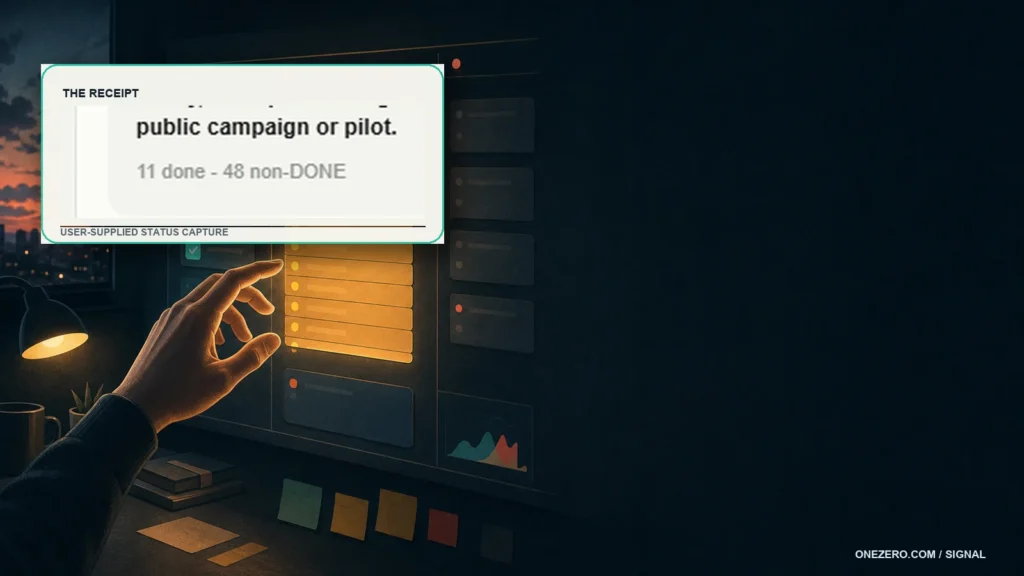
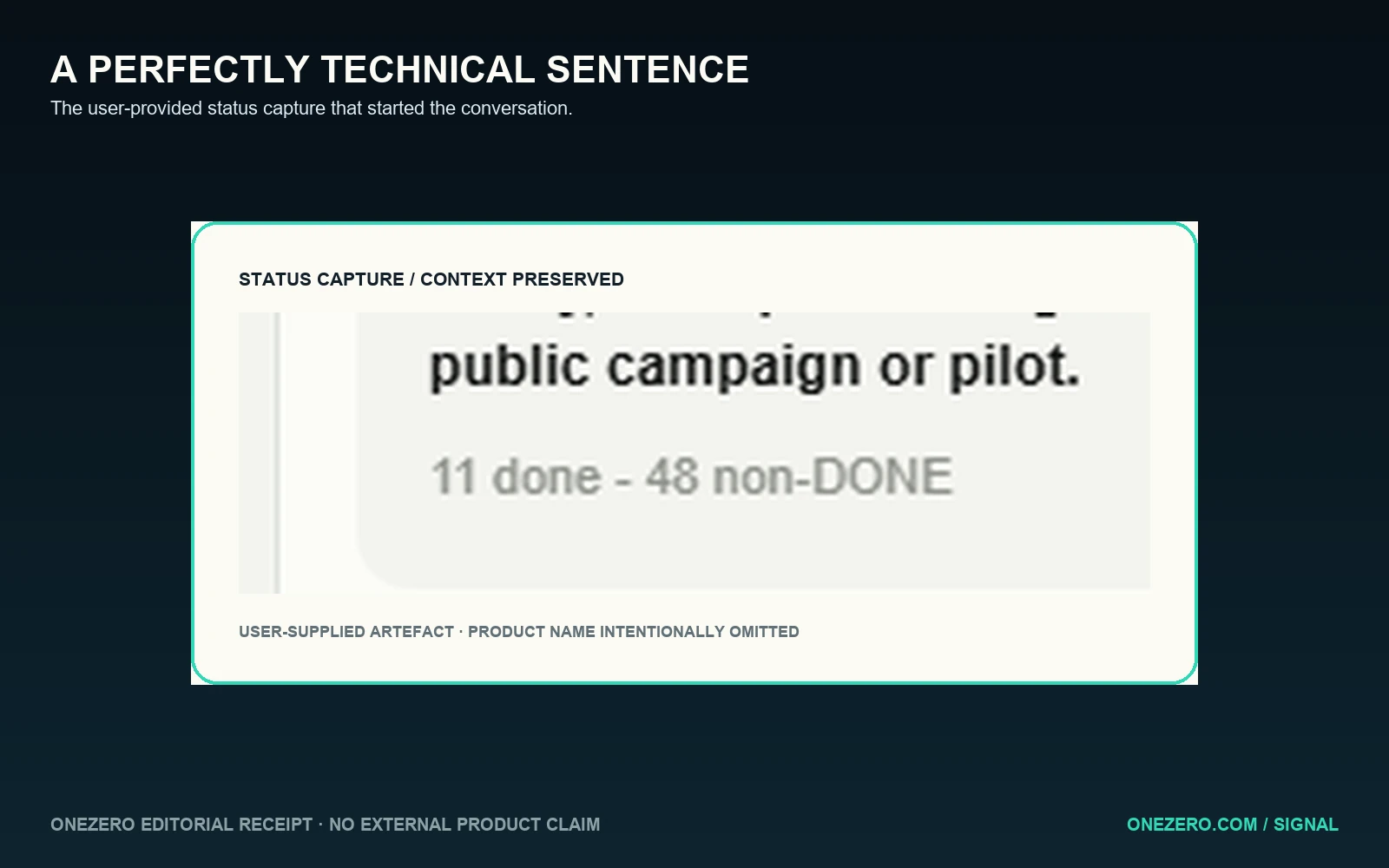
“11 done · 48 non-DONE” is the funniest thing an AI has said to me all year. Not because it is bad information. Because it is such exquisitely non-human information.
A person would say: “I did eleven. There are forty-eight I have not finished. Here is why. Here is what I need from you.” A person might say it badly, tiredly, dramatically or with an unnecessary “lol.” But they would understand that the sentence is a handoff, not just a count.
“Non-DONE,” meanwhile, is a tiny piece of accidental machine poetry. It sounds like a field in a database that has escaped into a conversation. It is technically adjacent to the answer. It is also the moment the interface stops pretending it knows what completion feels like.
items reached a system state the model recognizes as done.
items still carry context, choices, proof, ownership or consequence.
The screenshot has been making people laugh because it compresses an enormous question into a small absurd label. When is something done? Not when a workflow moved. Not when a model stopped typing. Not when a progress bar got bored. A thing is done when the person who owns the outcome can understand what happened, trust it enough for the present situation, and know what to do if it needs to change.
Why “non-DONE” feels like it came from another species
Software likes clean states because clean states are useful. A row can be queued, running, complete or failed. Those labels make systems operable. The trouble begins when we hand the labels to a human as if they are a complete explanation of a human situation.
“Non-DONE” is not false. It is simply a classification-level negative. It says what the status is not while refusing to say what the person should understand, decide or feel. That is why it has the flavour of a robot trying to pass a note in school: the grammar is there; the social move is missing.
Google’s People + AI guidance puts the underlying design issue in plain terms. People build mental models of an AI system from its language and behaviour. If a conversational interface refers to itself as “I,” users naturally infer more understanding than the software may have. Feedback, control and useful explanations matter because they let the person correct the model rather than decode it.
There are two definitions of done
Neither one is illegitimate. The problem is pretending they are interchangeable.
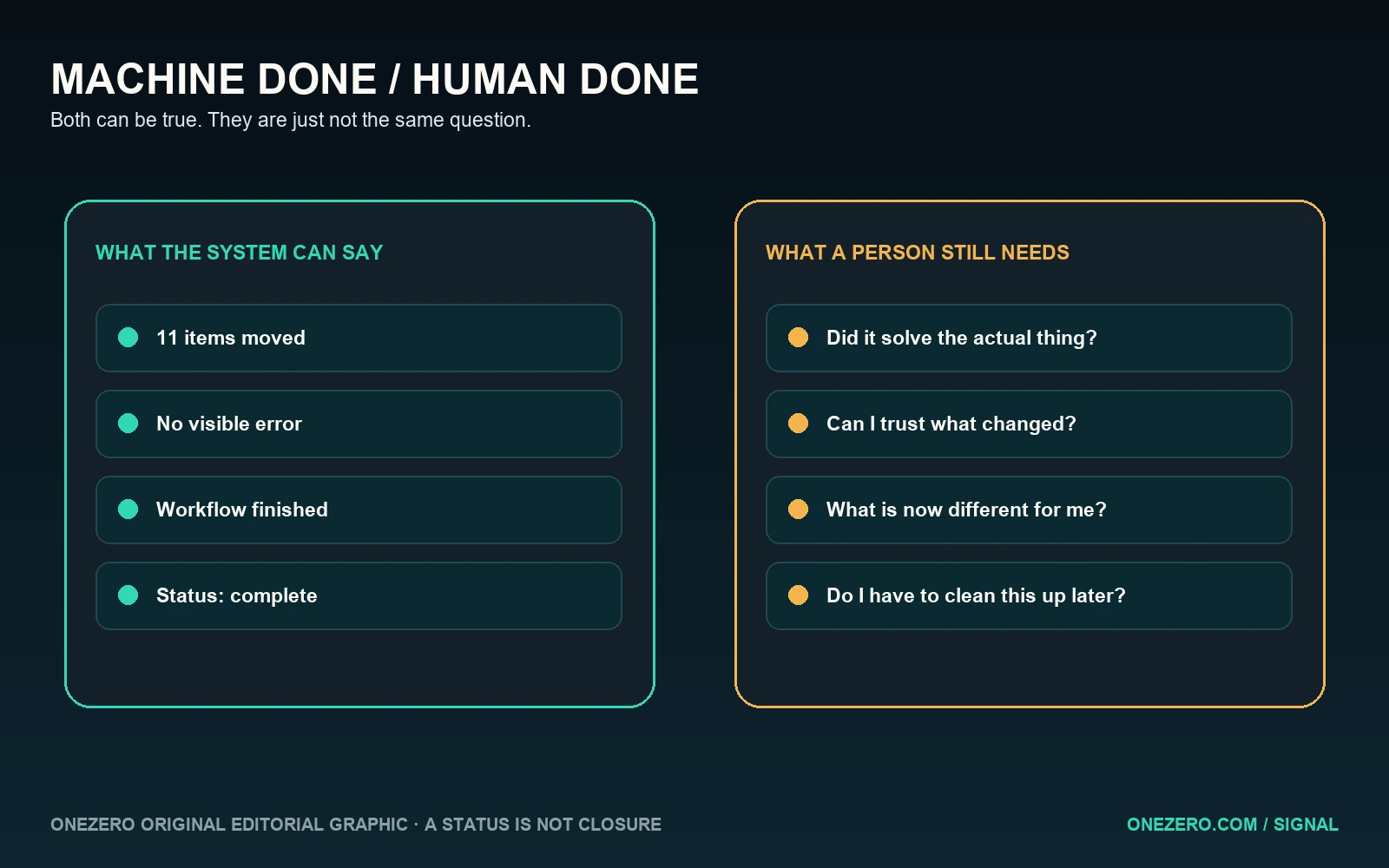
Machine done means an operation reached its programmed end condition. The file exported. The API returned. The status changed colour. That can be extremely valuable information. It is what computers are for.
Human done means the work is coherent in the real world. The person knows what changed. The person can see the thing. The exception has an owner. The loose end is named. The next person will not discover a surprise while trying to leave for dinner. This definition contains confidence, consequence and relief. It is necessarily messier.
That is why the “48” is not actually an insult to technology. It is evidence that the work still has a human-shaped remainder. A requirement may be ambiguous. A fact may need checking. An asset may be missing. A decision may belong to an owner rather than a model. The error is not that the assistant saw that remainder. The error is giving it a label that sounds like a loading spinner applied to a feeling.
What a real handoff sounds like
The best repair is delightfully boring. No personality theatre. No apologetic fog. No “rest assured.” No status category invented by a spreadsheet having a strange dream.
A good system answer gives the user four handles:
- What changed: “I completed 11 items.”
- What remains: “48 items still need a decision, source check or different action.”
- What is uncertain: “These 12 depend on information I cannot verify from here.”
- What you can do: “Review the 48 by impact, approve a batch, or tell me to stop.”
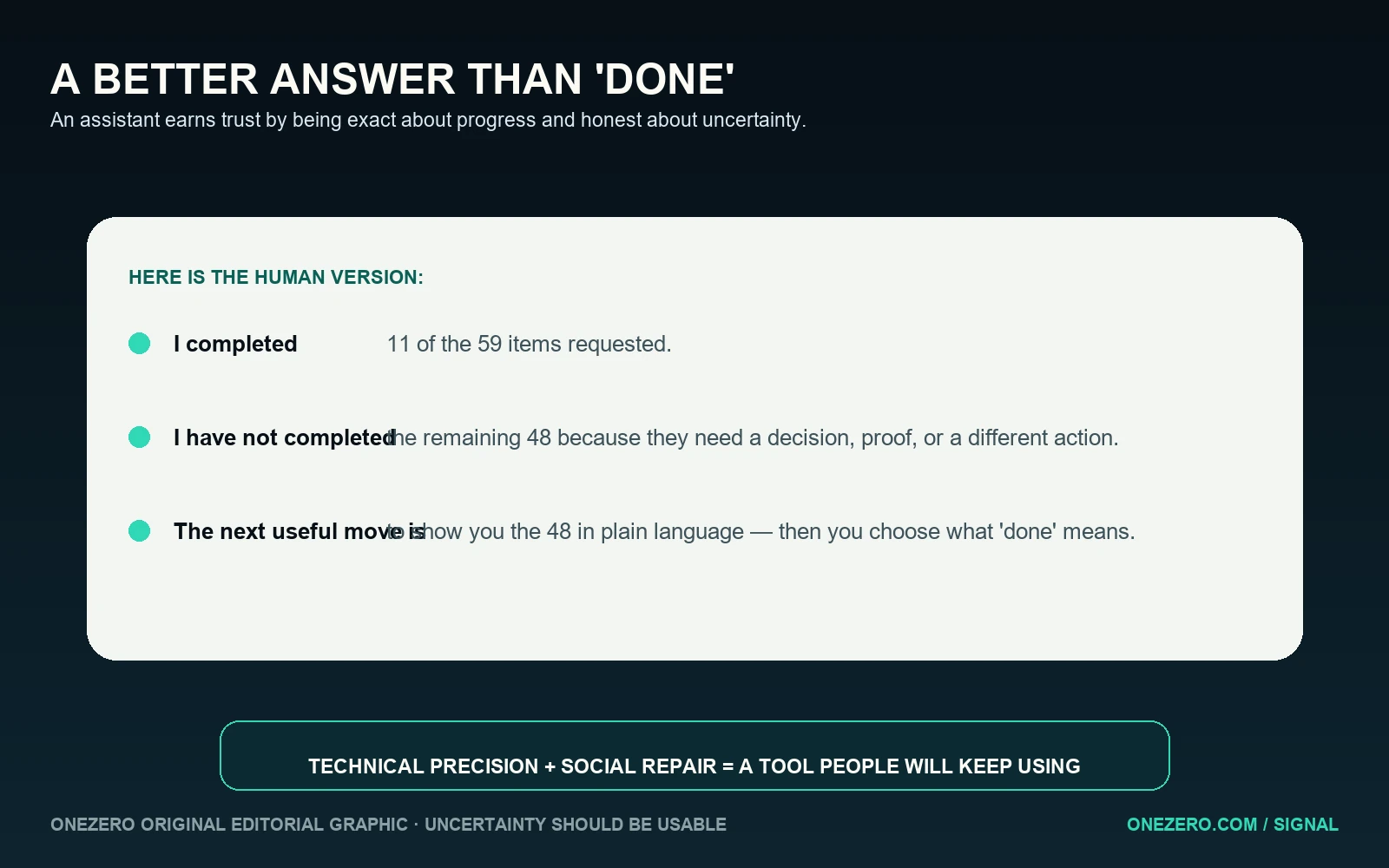
This is not just better writing. It is a safer operating model. The NIST Generative AI Profile emphasizes governance and the ability to manage risks, while research on dialogue breakdowns points to repair strategies such as clarification and disclosure. A status can be accurate and still fail the interaction if it leaves a person unable to recover.
The actual human part is not empathy theatre
There is a temptation to solve this by making assistants sound more affectionate. That is not the move. In fact, overly agreeable systems can make the gap worse: they give reassurance when they should give a boundary. The point is not to make software cosier. The point is to make uncertainty usable.
Human-feeling technology says, “I am not sure, and here is why.” It says, “I changed this one thing; the other thing is untouched.” It says, “I can show you the evidence.” It knows that “can I undo this?” is not a hostile question. It is a normal question from someone whose work, time and trust are involved.
We will still make jokes about “non-DONE,” because we should. It deserves to become a meme. But the phrase also deserves to become a product requirement: the interface must convert status into sense before it asks a person to act on it.
So: was it done?
Eleven things were done. Forty-eight were non-DONE. And one status line was accidentally perfect.
It names the limit of an automated system without meaning to: the computer may be able to tell us what state its tasks are in. We still get to decide whether the work is finished, whether the answer is good, whether the relationship is intact, and whether it is time to close the laptop.