Product launches train us to stare at specifications. The more useful Canadian question is often hidden at the bottom: will it be sold here, serviced here and priced like the same product? Google’s first Pixel Fold made the answer unusually plain. Not in Canada.
The Fold opened to a 7.6-inch inner display and carried a U.S. price of $1,799. It was the kind of device designed to dominate demonstration tables. In the Canadian version of Google’s announcement, one sentence did more work than the entire highlight reel: the Pixel Fold would not be released in Canada at that time.
That absence was not merely a disappointment for gadget collectors. It illustrated how geography shapes risk. A new form factor needs repair logistics, carrier testing, inventory, marketing and enough likely buyers to justify all four.
What actually changed
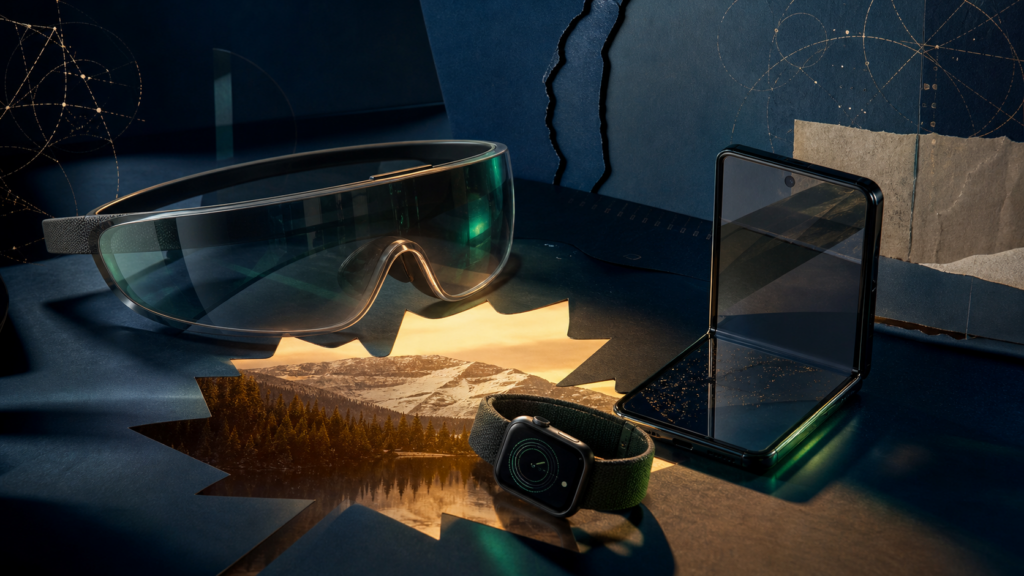
Google joined the folding-phone market with a book-style device that combined a conventional outer screen with a tablet-sized inner display. It also introduced the Pixel Tablet, sold with a charging speaker dock, and the lower-cost Pixel 7a.
The lineup showed three competing ideas about where personal computing should go: a phone that becomes a tablet, a tablet that becomes a home display and a familiar phone that borrows premium features. Only two of those experiments reached Canadian shelves.
How it works, without the launch-event fog
A foldable uses a flexible OLED panel beneath protective layers and a carefully controlled hinge. The screen bends along a defined radius rather than folding sharply like paper. The mechanical challenge is keeping dust, impact and thousands of cycles from turning a clever joint into the product’s weakest point.
Software must also adapt layouts as the device opens, closes and changes aspect ratio. A large screen is only valuable when apps use it intelligently. Otherwise the owner carries extra thickness and cost for stretched phone interfaces.
The Canadian reality check
Canadian shoppers can import unavailable devices, but that can introduce currency conversion, duties, incompatible network bands, uncertain warranty service and parts delays. A fascinating phone can become a poor purchase if a damaged inner display has no practical repair route.
The Fold’s absence also made the less glamorous Pixel 7a more relevant. At $599 CAD, it brought wireless charging and a 90 Hz display into Google’s A-series. Sometimes the technology that reaches more people is the real advancement.
Who should care—and who can wait
Early adopters could reasonably follow the Fold as a preview of Google’s software direction. Canadian buyers should have treated it as research, not a shopping recommendation.
Anyone choosing a foldable should price accidental-damage coverage and locate an authorized repair option before purchase. The hinge is exciting; the support path is what makes ownership tolerable.
What the announcement does not settle
A first-generation device cannot prove the durability of the category. Lab cycles do not reproduce grit in a pocket, winter temperature swings or a toddler discovering the hinge.
Nor does a large launch price reveal long-term value. Trade-in support, software updates and repair costs can matter more than the opening animation.
The OneZero verdict
The Pixel Fold’s Canadian story was an absence, and that made it useful. It reminded readers that availability is a feature and serviceability is part of the specification.
The best gadget coverage does not ask only what a device can do. It asks whether a person here can buy, maintain and live with it.